
The Calm Before the Intelligence Revolution - 2026 will be The Year Everything Changes

Most people around the world are still not aware of what is happening with artificial intelligence. 2026 will be the year that everybody wakes up to the acceleration. You could ignore it up till now, but you can’t ignore it going forward. We’re changing the basis of everything.
I want to help you understand what’s actually happening because we’re standing at one of those rare moments in human history when everything is about to change. 2025 will likely be recorded in economic and technological history as the final “normal” year, a period of deceptive stability where artificial intelligence, though prominent, largely functioned as a tool for augmentation rather than a fundamental architect of economic and scientific activity. The trajectory for 2026, however, signals a phase transition. Driven by the convergence of massive hardware scaling, the maturation of agentic architectures, and the deployment of embodied intelligence, 2026 is the moment the exponential curve of AI development goes vertical. It is the beginning of the new reality.
The foundation, the bedrock upon which our economy, our society, and our understanding of human capability rest, is shifting beneath our feet. There will be an earthquake in the structure that is built on top of it. I don’t say this to alarm you, but to prepare you. Think of it like standing on a beach watching the ocean pull back before a huge wave arrives. The water is still calm where you’re standing, but the physics have already changed. By 2026, the wave hits, and our economic and technological landscape transforms in ways that will touch every aspect of our lives.
Let me first show you what happened recently to give you a perspective on where we are in late 2025.
Something extraordinary happened recently with the release of GPT-5.2, and it represents a threshold we’ve never crossed before. For years, artificial intelligence has been impressive at narrow tasks, but this is different. This is the moment when AI became genuinely better than humans at knowledge work itself, the kind of work that fills offices and defines careers.
The evidence comes from GDPval, which is a benchmark designed to measure what actually matters in the economy. Unlike abstract tests, GDPval evaluates AI on real professional tasks across 44 occupations and 1,320 tasks spanning the nine industries that contribute most to economic output. We’re talking about creating workforce planning models, building sales presentations, designing manufacturing diagrams, preparing accounting spreadsheets, or developing healthcare schedules. These aren’t simplified exercises; they’re the actual artifacts that professionals produce after spending an average of seven hours working on them.
The result? GPT-5.2 beats or matches top-tier human professionals 70.9% of the time, according to expert judges who evaluated outputs side by side. Not junior employees or average workers, but experts. The kind of professionals who command premium rates because of their specialized knowledge and years of experience. The machine wins seven times out of ten.
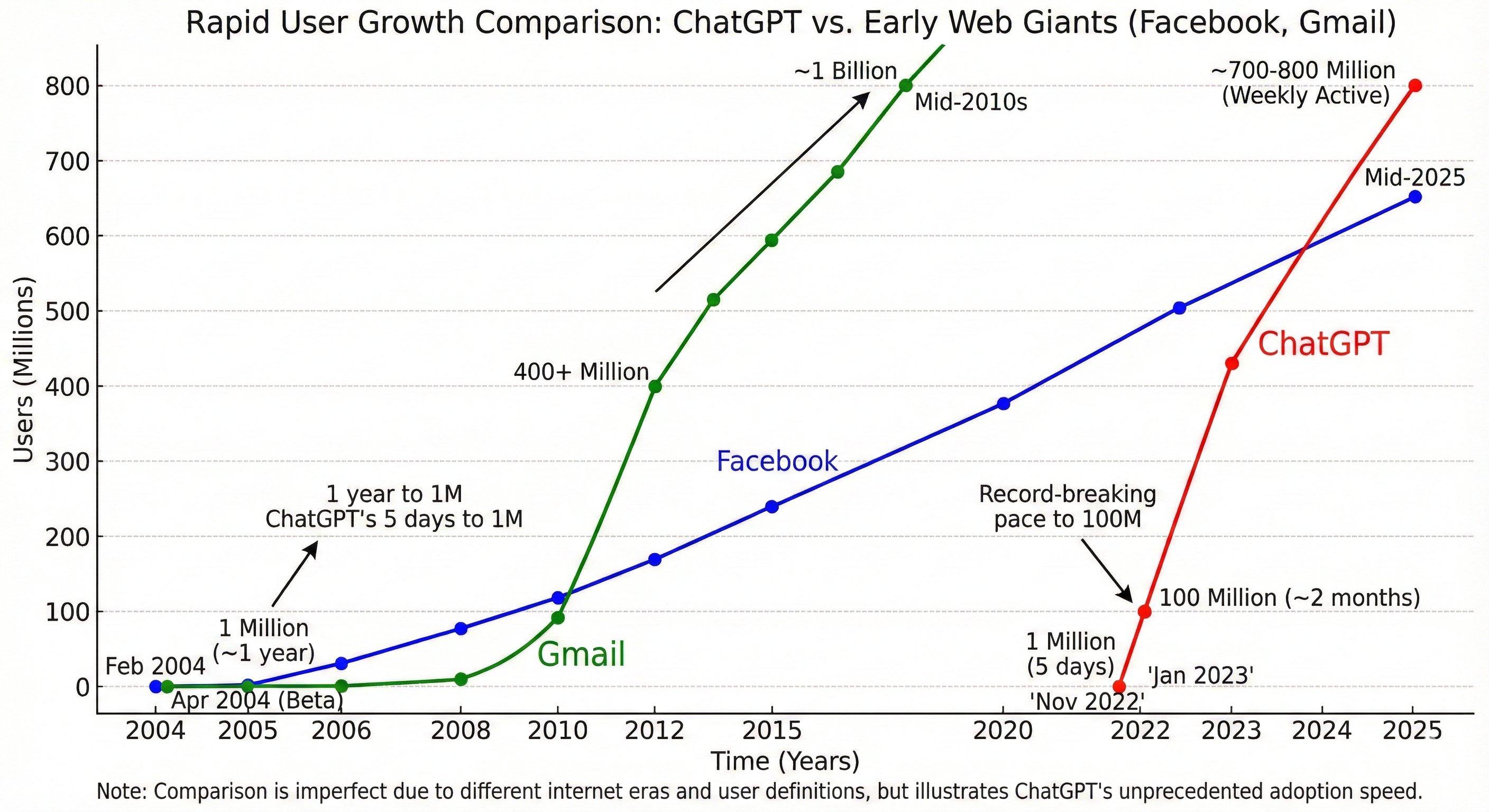
Combine that with the fact that AI has become the fastest-adopted technology in human history, with ChatGPT reaching 800 million weekly active users in under three years, and you have the setup for a massive transformation. The capabilities are almost there, and the adoption is faster than anything we’ve seen in history.
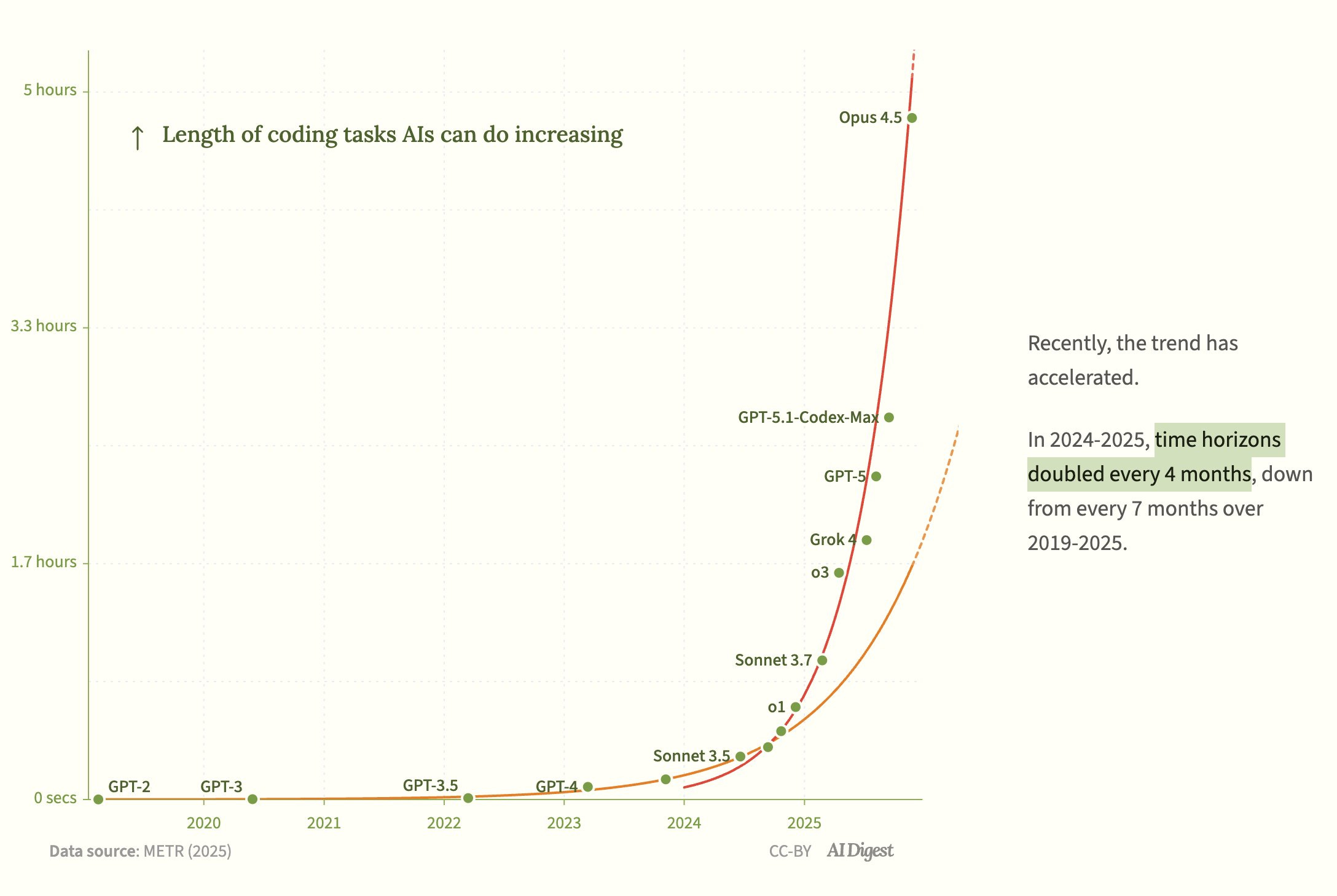
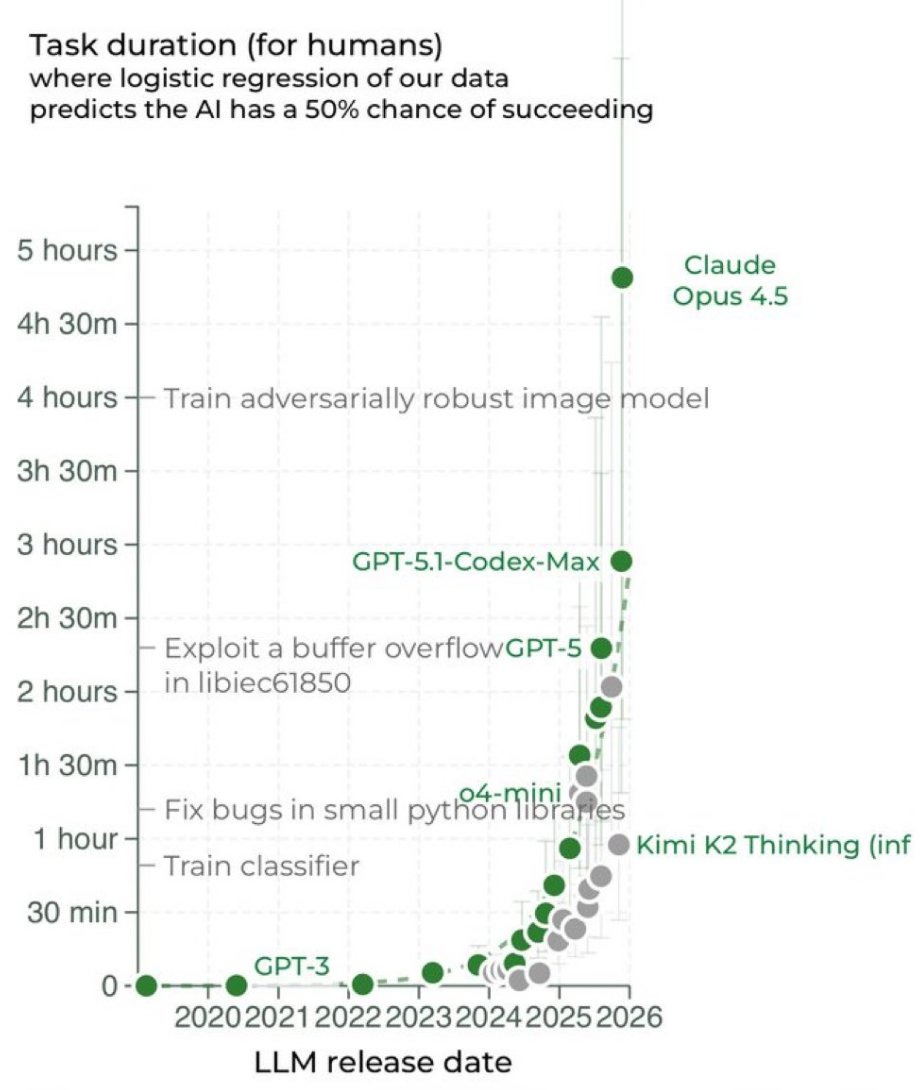
The exponential curve is beginning to get even steeper. METR has just confirmed that Claude Opus 4.5 can now work autonomously for four hours and 49 minutes straight, and it’s not just an incremental improvement. This leap is so substantial that it aligns perfectly with what researchers call a “fast timeline” variant of the “AI 2027” scenario. You see, we’re not just watching AI agents handle longer tasks. We’re witnessing something far more remarkable: exponential growth that’s actually accelerating. Until 2024, the duration of tasks these agents could manage doubled every seven months. Now that doubling happens every four months. If this trajectory holds, and there’s every reason to believe it will, we’ll see AI agents completing a full eight-hour workday by April 2026. By mid-2026, they’ll manage two consecutive days of work. By year’s end, they’ll handle half a week independently. This isn’t science fiction. This is the mathematics of progress unfolding before our eyes.
If you listen to what the AI researchers themselves are saying, you’ll hear something remarkable. Anthropic’s Stephen McAleer has made a fascinating pivot: he’s now focused entirely on automated alignment research, believing that human oversight alone can’t keep pace with what’s coming. Google’s Noam Shazeer puts it even more starkly. He now gives it 50/50 odds that the next major breakthrough in AI research won’t come from a human researcher at all but from Gemini itself. OpenAI’s Mark Chen projects that AI interns are about to transform research. Within a year, expect AI to handle implementation and debugging, letting researchers focus on big ideas. We’re not talking about AI as a tool that helps scientists work faster. We’re talking about AI conducting the research, generating the insights, and building the next generation of itself. This is recursive self-improvement, the moment when the system begins to improve its own capabilities. It’s a threshold we’ve theorized about for years, and now we’re watching it materialize.
To round out the state of AI in late 2025 a look at robotics, because intelligence isn’t staying confined to the digital realm. China’s CATL has already deployed humanoid robots at scale in their battery production lines. The artificial minds we’ve been developing are stepping into physical form, working alongside us in factories and facilities. What was once abstract code is becoming tangible, present, and integrated into the fabric of our industrial world.
Now, I can imagine what you’re thinking. You’ve heard bold claims about AI before, and many haven’t materialized as dramatically as promised. But what’s different this time is the convergence of three massive forces that are all accelerating simultaneously, and understanding these forces will help you see why 2026 represents an inflection point.
The first force is the staggering infrastructure buildout happening right now. NVIDIA’s Blackwell architecture represents a discrete jump in computational capability that makes previous generations effectively obsolete for cutting-edge AI training. The technical leap comes from a shift to something called FP4 precision, which allows for training performance that’s up to three times faster and inference throughput that’s 15 times higher than the previous generation. This isn’t merely a speed upgrade; it’s a capability unlock. Think of it like the difference between having a bicycle and suddenly having access to a car. The types of problems you can tackle change fundamentally.
By 2026, it’s predicted that at least five sites worldwide will surpass the one-gigawatt capacity threshold. One gigawatt is roughly equivalent to the electricity use of about 700,000 homes. To put that in perspective, Amazon’s new data center campus in Indiana is so massive it’s practically a small city, using 2.2 gigawatts of power.
Google has told employees it must double its AI serving capacity every six months, aiming for a 1,000-times increase over the next four to five years. This isn’t hypothetical future planning; this is happening right now, with billions of dollars already committed.
The second force is the shift from chatbots to agentic AI, and understanding this distinction is crucial. A chatbot answers your questions; an agentic system pursues your goal. It’s the difference between a calculator and an assistant. A chatbot might write a report if you ask for it. Agentic AI takes your objective, breaks it into steps, figures out what information it needs, gathers that information from multiple sources, adapts its approach based on what it learns, and delivers the complete solution. It plans multi-step workflows, uses tools autonomously, learns from outcomes, and adapts in real time.
This capability emerges from three technical breakthroughs working together. First, there’s inference-time reasoning, where models use something called chain-of-thought to explore solution paths, verify logic, and self-correct before committing to answers. Rather than just predicting the next word, these systems actually think through problems step by step. Second, there’s multimodal integration, which means AI can now process text, images, video, audio, and code through unified architectures. It can analyze a circuit diagram, read component specifications, and simulate behavior in ways that approximate how humans think. Third, there’s tool integration and planning, where AI systems don’t just generate text; they use software tools, call functions, integrate databases, and chain operations across multiple systems. The AI model becomes the brain of a larger system.
Underpinning the rapid development of capabilities in 2026 will be the progress in post-training, which is the learning phase after the initial training of an AI model. At the same time, you’ll see the sheer scale of these models take another leap forward. Quantization is going to play an outsized role in making this power accessible. Think of it as a clever technique that compresses these massive systems into smaller ones without losing their intelligence, so they cost less to run.
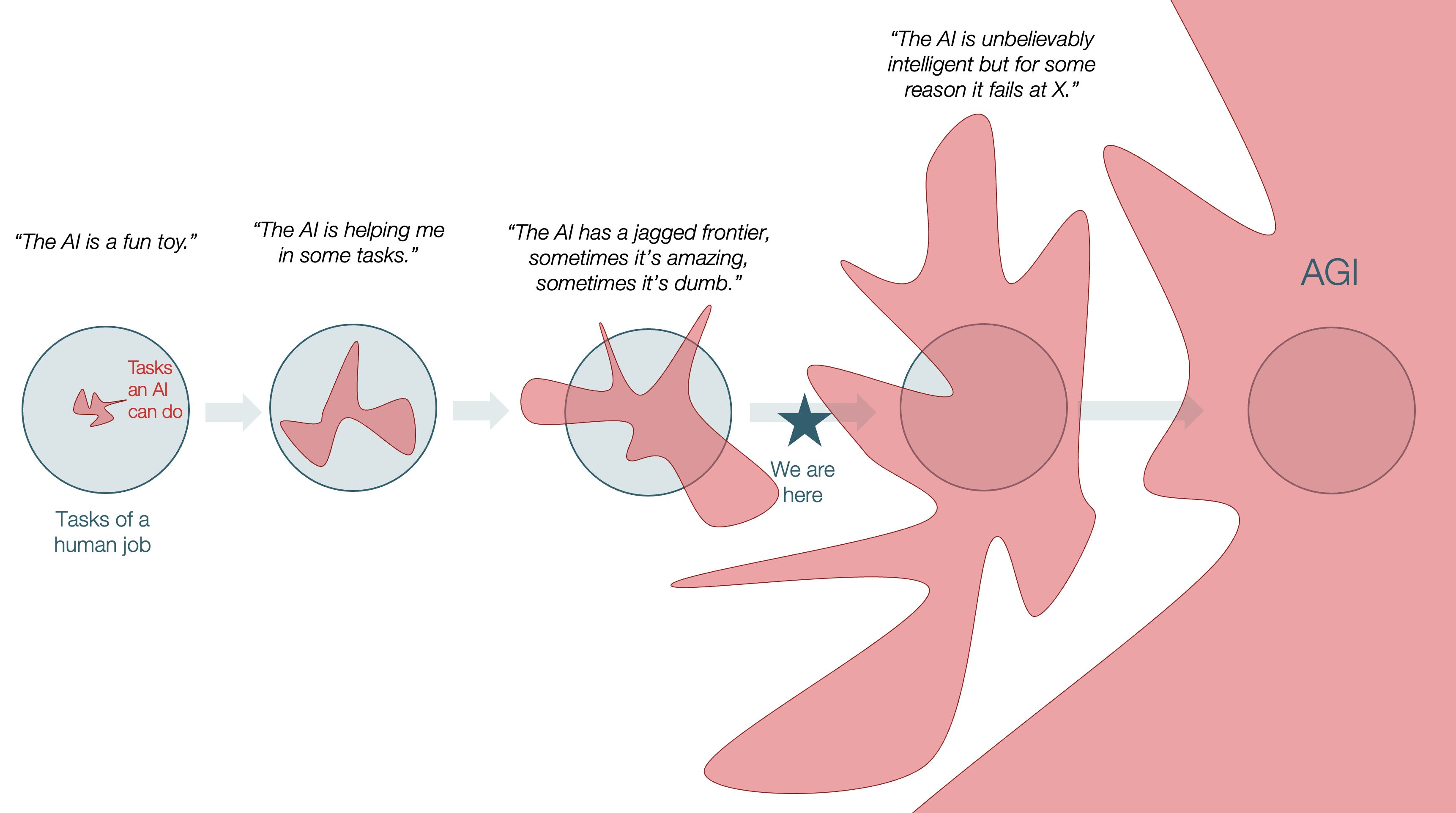
By the end of 2026, we will look at artificial intelligence that can think, understand, generalize, and perform almost all knowledge work at or above human level. We will see the “jagged frontier” of AI capabilities, where models excelled at some tasks but failed at others, smooth into a broad plateau of competent, autonomous agency. The “jagged frontier” is the idea that machine intelligence surges past some of the things humans can do while lagging in others. For instance, large language models are already superhuman coders but have trouble counting fingers in pictures. What we’re witnessing is that machine capabilities will become a superset of human capabilities.
Coding isn’t the only domain approaching expert performance. Research acceleration, financial analysis, supply chain optimization, drug discovery, or clinical diagnosis - each domain experiences the same compression. Tasks once requiring specialized human expertise are now completed in minutes with agentic systems coordinating across data, tools, and reasoning loops.
By 2026 agentic systems will operate 24/7 without fatigue, maintaining context and learning from outcomes. They can operate at a large scale, with millions of agents across organizations. And they can operate cheaply, where the marginal cost per task will approach zero.
The third force, and perhaps the most thrilling, is AI’s transition from a system that aggregates existing human knowledge to one that generates novel insights. This is where the story becomes truly extraordinary. In 2026, AI systems will cross the threshold to figure out things we’ve never known before. We’re already seeing the initial stages in the last few weeks in math with the new automatic provers. AI starts to solve mathematical problems one by one, often more elegantly than humans have managed. The math community is grappling with what this means for the fundamental nature of their field.
The ultimate goal is to convert computational power into new discoveries, and we’re watching this happen in real time. The US Department of Energy launched the Genesis Mission, a massive public-private partnership involving NVIDIA, OpenAI, Google, Anthropic, and Microsoft to accelerate scientific discovery. These aren’t incremental improvements to existing research methods. This is about AI executing the entire scientific loop: reading literature, generating hypotheses, designing experiments, writing code, analyzing results, and proposing new avenues of inquiry. AI will begin to unlock breakthroughs in physics, chemistry, material science, biology, medicine, and energy.
Imagine what becomes possible when we can explore solution spaces at computational speed rather than human speed. Problems that might take decades to solve through traditional methods could yield to solutions in months or even weeks. This isn’t science fiction; the infrastructure and algorithms are already being deployed.
Now, let’s talk about what this means for the economy and for work itself, because this is where the transformation becomes deeply personal.
All major AI companies are working on systems that can perform the work of doctors, lawyers, accountants, and dozens of other professions. In 2026, they will cross that threshold for many of these roles. AI is projected to surpass 90% on GDPval by the end of 2026, meaning a vast amount of knowledge work as currently structured can be automated. Companies will adopt AI agents and transform their workforce composition, driven by massive efficiency gains. By the end of 2026, you won’t be able to tell if a coworker is an AI or a human in many contexts. Full-stack solutions will emerge with AI accountants, lawyers, marketers, and more.
While the AI capabilities will be there, the infrastructure to safely integrate them into enterprise systems takes a little more time. This creates what’s called an “output gap,” the disconnect between what’s technically possible and what’s actually deployed at scale. Companies must navigate security frameworks, legal questions, compliance requirements, and change management. But the economic pressure is immense. When one organization can produce expert-level knowledge work at one percent of the cost of its competitors, those competitors must adapt or face economic irrelevance.
During 2026 we will reach the moment when AI deployment becomes economically irreversible. Until now, AI adoption was a strategic choice, something companies could defer, do partially, or abandon if it didn’t work out. By 2026, companies that deploy agentic systems at scale will get competitive advantages so significant that late movers cannot catch up. This is when the workforce transformation becomes visible and politically salient. When millions of entry-level and mid-career professionals simultaneously discover their skills are automated. When unemployment emerges in specific, visible ways.
I know this sounds unsettling, and it should prompt serious questions. How do we create a safety net for people whose skills become automated? Where will value be generated in society, and how do we distribute it? These are the most important questions we’ll face from a societal perspective, and we need to address them now. The social contract is being shredded, and we need to rebuild it in a very rapid way. We have the opportunity to shape what comes next. Whether through universal basic income, universal basic services, or entirely new frameworks, we can use AI and automation to bring the costs of living down dramatically while ensuring dignity and opportunity for everyone.
Our education systems, designed to train young people to be ready for the job market, face a profound challenge. We have no clear picture of what jobs will look like in two, three, or certainly five years. What should we be teaching? This uncertainty will force a radical reimagining of how we prepare people not for jobs, but for lives of meaning and contribution in a world where traditional employment may look very different.
The transformation extends beyond office work. In 2026, humanoid robots will be deployed in growing numbers across practical tasks, collecting real-world training data that rapidly improves their capabilities. Combining reinforcement learning capabilities and massive compute to create very powerful world models for training robots and vehicles in the virtual world, we will get fully autonomous robots capable of navigating the physical world and level 5 vehicles with fully generalized autonomy.
This is the automation of physical labor. Goldman Sachs projects 50,000 to 100,000 humanoid units shipped globally in 2026, with manufacturing costs declining toward $20,000 per unit as production scales up. Companies like Tesla and Figure AI are preparing commercial deployments. The production for mass consumption is going to take time; the supply chain isn’t there yet to fill all the demand. The capability will exist in 2026; the question becomes how quickly they can be produced and how we manage the transition. When organizations can produce physical labor for a dollar an hour, the economic pressure to deploy it will be immense.
The change that is coming will be way bigger than the Industrial Revolution, which took a century to unfold. The transformation we’re witnessing with artificial intelligence is compressing a way bigger magnitude of change into a single decade, and it’s everywhere simultaneously. We’re talking about a change so profound that the way we live will be unrecognizable by 2035.
2025 was the last normal year. 2026 is the beginning of something new. Something extraordinary. Something that requires all of us to think bigger, to imagine different futures, and to rebuild our social contracts and economic systems for a world where intelligence is no longer scarce.
Here’s what I want you to take from all of this. Yes, we’re facing unprecedented change. Yes, it will be serious; there will be disruption and dislocation. How much lies in our hands and our ability to stand up for a better future. But we’re also gaining extraordinary power to solve problems that have plagued humanity for generations. Climate change, disease, hunger, energy scarcity, or material limitations. All of these challenges become tractable when we can apply intelligence at a computational scale. With it comes the opportunity to pivot to a new social and economic system that overcomes the self-destructive capitalistic system that is exploiting human labor for more and more profit and leaving humans struggling, unhealthy, and unhappy.
The anxiety you might feel reading this is natural, but consider the opportunity. We’re not passive observers of this transformation; we’re participants in shaping it. The decisions we make in 2026 about how to deploy these capabilities, how to share their benefits, and how to protect human dignity and agency will echo for decades.
What’s required now is not fear, but engagement. Understand what’s happening, engage in the conversation, ask hard questions about how these systems should be governed, demand from your governments that the benefits flow broadly rather than concentrating narrowly, and start thinking creatively about what human contribution and meaning look like when machines can handle much of the work we currently do.
The wave is coming. We can’t stop it, but we can learn to ride it. And if we do this right, we might look back on 2026 not as the year we lost something, but as the year we gained the tools to build a world more prosperous, fulfilled, healthier, and full of possibility than anything we’ve known before.
We’re living through one of the great transitions in human history. That’s not hyperbole; it’s simply the reality of what’s unfolding. The question isn’t whether this transformation happens. The question is how we respond to it, what we choose to build with these new capabilities, and whether we rise to meet this moment with wisdom and courage.
I believe we can. And I believe 2026, for all its disruption, represents not an ending but a new beginning.
Thanks for reading! Subscribe to receive the latest articles. If my content resonates with you, supporting me with a paid subscription is a wonderful way to say “thank you.” It helps me dedicate the time needed to keep writing.
I will read this next December